

When Your Dentist Says, ‘A Lot Is Going On’—Here’s How to Make Sense of It
You leave a dental appointment expecting a cleaning summary and maybe a small cavity. Instead, you get a list—extractions, dental crowns, dental implants, gum treatment — and a number that makes your stomach drop. You nod along, take the paperwork, drive home, and wonder, where do I even start?
You’re not alone. This happens to more patients than you’d think, and it rarely means what people fear it means: that the situation is hopeless, the cost is unsurvivable, or that somehow you failed. What it usually means is that several problems developed quietly over time and are now visible all at once.
At Mint Dental in Pearl, MS, Dr. Alexa Lampkin hears some version of this story almost every week. Patients come in having been told they need “extensive work” by another provider—or simply knowing their mouth hasn’t felt right for years—and they need someone to sit down with them and explain what’s actually happening and what comes next.
This post is that conversation. We’re going to walk through what “extensive work” typically means, what a full-mouth reconstruction actually involves, and why starting the process—even slowly—is almost always better than waiting.
Have questions? Contact our Pearl dental office today at (601) 882-5600 to schedule your consultation. We welcome patients in Pearl, Brandon, Richland, Jackson, MS, and more.
“Extensive Work” Is Not a Diagnosis—It’s a Description
When a dentist says you need extensive work, they’re not using a clinical term. They’re telling you that your situation involves more than one or two isolated problems—that multiple teeth, and possibly your gums or bone, need attention at the same time.
That phrase tends to show up in a few different scenarios:
- Multiple teeth with deep decay that have progressed beyond simple tooth-colored fillings
- Missing teeth that have caused surrounding teeth to shift and bone to deteriorate
- Advanced gum disease (periodontitis) that has affected the foundation holding your teeth in place
- Years of grinding (bruxism) that have worn teeth down, changed your bite, and caused sensitivity or cracking
- Old dental work — crowns, bridges, dentures — that’s breaking down and needs to be replaced
- Trauma or injury that damaged several teeth at once
In dentistry, when several of these things are happening simultaneously, the appropriate response is a full mouth reconstruction: a coordinated, sequenced treatment plan that addresses every issue in the right order so that each step supports the next.
The keyword is “coordinated.” This isn’t a menu of procedures you pick from randomly. It’s a roadmap—built around your specific anatomy, your health, and your life—that moves from foundation to function to finish.
Why Problems Tend to Show Up All at Once
One of the most common questions Dr. Lampkin gets from new patients is some version of “How did it get this bad without me knowing?”
The honest answer is that dental problems are remarkably good at hiding. Tooth decay doesn’t hurt until it reaches the nerve. Gum disease is painless in its early and middle stages. Bone loss after tooth extraction happens silently. Teeth shift gradually—so gradually that you stop noticing.
By the time discomfort, sensitivity, or a visible change brings someone in, the process has often been underway for years.
This is especially true for patients who delay dental visits—whether because of cost, anxiety, a lack of insurance, or simply life getting in the way. It’s also true for patients who saw dentists regularly but never had a provider step back and look at the full picture.
A few statistics help illustrate how common this is:
- According to the CDC, nearly half (46%) of adults over 30 in the United States have some form of periodontal disease—and most don’t know it.
- The American College of Prosthodontists reports that over 36 million Americans are missing all of their teeth, and 120 million are missing at least one tooth. Tooth loss compounds quickly—one missing tooth changes how neighboring teeth bear force.
- Research published in the Journal of Dental Research found that untreated decay in permanent teeth is the most prevalent health condition worldwide, affecting approximately 2.3 billion people.
None of this is meant to alarm—it’s meant to normalize. If you’re sitting with a treatment plan that feels overwhelming, you’re in very common company. The difference is that you now know, and knowing means you can act.
What Full Mouth Reconstruction Actually Involves
The term “full mouth reconstruction” can sound dramatic. In practice, it simply means that your dentist is treating your mouth as a system—not as a collection of individual teeth—and building a plan that addresses everything that needs attention in a logical sequence.
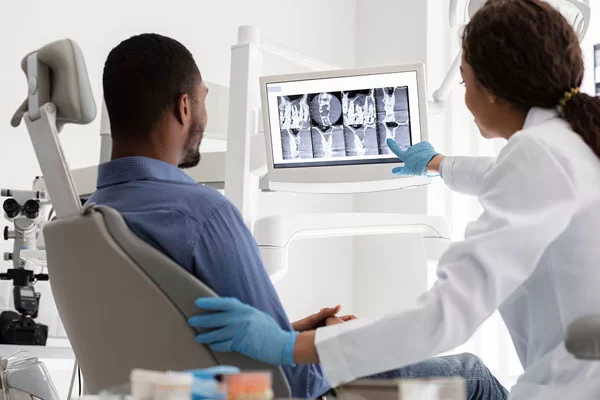
At Mint Dental in Pearl, Dr. Lampkin uses 3D digital imaging to map each patient’s anatomy before treatment begins. This isn’t standard at every practice—most still rely on traditional two-dimensional X-rays—but it allows her to see bone density, nerve pathways, and structural issues that a flat image would miss. It’s also how she builds implant placement plans that are precise rather than approximate.
Here’s what the process typically looks like:
Before anything is recommended, Dr. Lampkin conducts a complete clinical exam: every tooth, the gum tissue, the bite, the jaw joint, and a review of your medical and dental history. For complex cases, this includes CBCT (3D cone beam) imaging. The goal is to understand the complete picture before proposing a single procedure.
You receive a written breakdown of every procedure recommended, in the order it should be done, with an estimated timeline and itemized cost. You review this with Dr. Lampkin before anything is scheduled. There are no surprises, and nothing moves forward without your understanding and agreement.
If gum disease is present, it’s treated before restorations begin. If teeth need to be extracted, that happens before implants are placed. If bone grafting is needed to support implants, it’s done with enough lead time for healing. This sequence matters enormously—skipping it is the most common reason reconstructions fail prematurely.
This phase addresses the teeth themselves: implants to replace missing roots, crowns to protect compromised teeth, bridges to span gaps, and any other structural work. Where implants are placed, a healing period—typically three to six months—allows the implant to integrate with the bone before the final crown is attached.
Once the structural work is complete and stable, cosmetic procedures like porcelain veneers or teeth whitening can be done to finalize the aesthetic result. Doing cosmetic work before the structural foundation is stable risks having to redo it—which is why sequence matters.
Long-term success depends on consistent professional care. Dr. Lampkin provides a personalized maintenance schedule, including cleaning intervals and periodic imaging, to protect the investment you’ve made. This is where most of a reconstruction’s longevity is determined.
The Procedures Most Commonly Involved
No two reconstruction plans are identical, but several procedures appear frequently. Here’s a plain-language overview of the most common ones:
Titanium posts are placed in the jawbone to replace missing tooth roots. They support crowns, bridges, or full-arch restorations like All-on-4. Implants are the closest thing to a natural tooth that dentistry currently offers—they preserve jawbone, function like natural teeth, and, with proper care, can last decades.
Custom-fitted caps that cover a damaged or severely decayed tooth, restoring its shape, strength, and appearance. Crowns are often the workhorses of a reconstruction—protecting teeth that have been weakened by large fillings, cracks, or root canal treatment.
Deep cleaning (scaling and root planing) removes bacteria and buildup from below the gumline. More advanced periodontitis may require additional therapy. No reconstruction holds without healthy gums—this is why it’s always the first step.
If tooth loss has caused the jawbone to deteriorate, bone grafting rebuilds the volume needed to support implants. It’s a preparatory step, planned at the initial consultation, that prevents complications later in treatment.
For patients who have lost most or all of their teeth, dentures restore function and appearance. Implant-retained dentures snap onto implants for a secure fit—eliminating the slippage and adhesive dependency of traditional dentures while dramatically improving chewing ability.
Ultra-thin shells are bonded to the fronts of teeth to correct chips, discoloration, gaps, or misshapen teeth. In a full mouth reconstruction, veneers typically handle the cosmetic refinement of the front teeth once the structural work is complete.
What About the Cost? And the Time?
These are the two questions that stop most people from moving forward — and they deserve honest answers.
Full mouth reconstruction cost varies widely depending on which procedures are involved, how many teeth need treatment, and whether preparatory steps like bone grafting are required. A case involving a few crowns and gum treatment costs significantly less than a full-arch implant restoration.
What Mint Dental guarantees: you will receive a complete, itemized cost breakdown before any treatment begins. No surprises. No pressure. The team also helps you understand your insurance benefits—many restorative procedures receive at least partial coverage—and works with you on financing options, including CareCredit, Sunbit, and flexible monthly payment plans.
Patients without insurance can ask about discount programs for select services. The goal is to make necessary care accessible, not to push treatment that doesn’t fit your life.
Simple reconstruction cases—a handful of crowns and gum treatment—may wrap up in a few months. Cases involving implants, bone grafting, and multiple restorations can take 12 to 18 months, largely because implants require a healing period before the final crown is placed.
Dr. Lampkin provides realistic timelines at the consultation—not optimistic ones. Understanding the full arc upfront helps you plan around work, family, and finances without being caught off guard mid-treatment.
One useful way to think about it: if you start a consultation this spring, you could realistically have a significant portion of your treatment completed by fall. The patients who say they wish they had started sooner almost always wish they had started now, not later.

Why Patients in Pearl Choose Dr. Lampkin for Complex Cases
There are many dentists in the Pearl and Jackson metro area. What makes Mint Dental different comes down to the depth of Dr. Alexa Lampkin’s training and the way her practice is run.
Dr. Lampkin, DMD, is a graduate of the UMMC School of Dentistry with an Advanced Education in General Dentistry residency. She served as the youngest assistant professor at UMMC’s School of Dentistry and remains part-time faculty—meaning she is actively involved in shaping how Mississippi’s next generation of dentists is trained.
She was the first African American female president of the UMMC Dental Alumni Board (2022) and the first female dentist appointed to the Mississippi State Board of Dental Examiners by the governor (2022). In 2024, she completed an Executive Master of Science in Population Health Management from UMMC.
Beyond credentials, patients consistently describe a practice that takes time to explain — not just treat. If you’ve avoided the dentist because you felt rushed, dismissed, or overwhelmed by a previous experience, that pattern is something Dr. Lampkin and her team take seriously.
Mint Dental uses 3D digital imaging and offers sedation options for patients who experience dental anxiety—two features that matter significantly when treatment is complex and the stakes are high.
Spring Is Actually a Smart Time to Start
If you’ve been putting off dealing with dental work that felt too big to tackle, mid-spring is a practical time to act—and not just because the weather is nicer.
Tax refund season means many patients have funds available that they didn’t have in January. The busy holiday season is behind you. Summer, with its weddings, family gatherings, graduations, and photos, is roughly ten weeks away. And for cases involving implants, starting a consultation now means treatment phases that require healing time can begin before summer arrives.
You don’t need to commit to a full treatment plan at your first appointment. You just need to come in and understand what you’re working with. The consultation is where clarity begins — not where commitment ends.
How to Make Sense of Your Dentist’s Extensive Dental Work
The most common thing patients tell Dr. Lampkin after their first consultation is that they wish they had come in sooner—not because the news was good, but because having a clear picture finally felt manageable.
You don’t have to keep carrying the weight of a smile you’re avoiding. A consultation gives you a complete, honest picture of your situation, a written treatment plan with real costs and a real timeline, and a care team that moves at your pace.
Mint Dental welcomes patients from Pearl, Brandon, Richland, and Jackson, MS, and surrounding communities throughout Rankin County.
Call us at (601) 882-5600 or visit us at 190 Riverwind E Dr., Suite 201, Pearl, MS 39208, to schedule your consultation with Dr. Alexa Lampkin, your Pearl dentist at Mint Dental.
Your next step doesn’t have to be treatment. It just has to be the conversation.